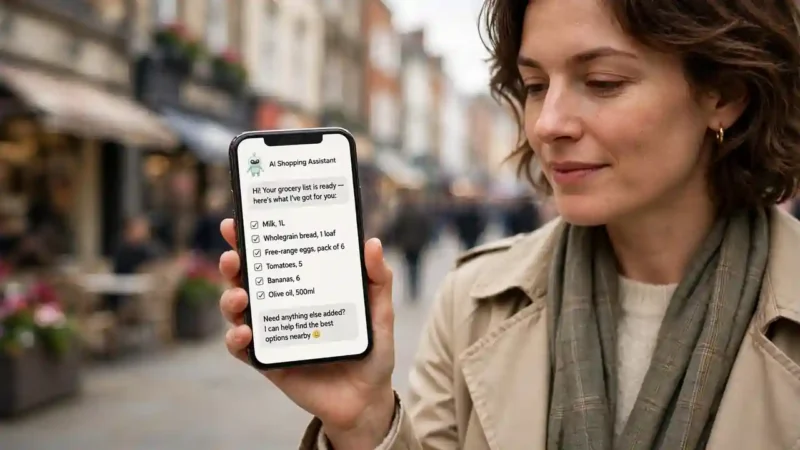
On 19 November 2026, two announcements arrived on the same day in Singapore, and together they describe the next change in AI agent payments. Mastercard showed a live purchase made by an AI agent through Antom, the merchant payment platform from Ant International, and said it had completed a pilot of its Agent Pay for Machines service in Singapore. On the same day, Visa unveiled Visa Recurrent, a subscription management tool, on day two of the Singapore FinTech Festival 2026. Neither product is something most shoppers can use today, but the direction is clear: the card networks are building controls to let software spend money for you.
A coffee bought by software, not by a person

Mastercard said on 19 November 2026 that an AI agent bought a cup of coffee through Antom, using instructions the consumer had set in advance. Antom handled acceptance for the merchant, and the payment ran on Mastercard Agent Pay with Verifiable Intent. It was a single small purchase, and it was a demonstration, not a public launch.
The coffee matters for what it proves. Until now, most AI shopping tools could search, compare and fill a cart, then stop at the payment step. In this transaction, the agent completed the payment itself, acting on instructions the consumer had already given. Mastercard called it a live consumer transaction, meaning real payment rails were used. The payment ran through Mastercard Agent Pay, which combines network tokenisation, authentication and consumer intent, so neither the merchant nor the agent sees the real card number.
Mastercard has not said when US shoppers will be able to use this, which merchants will accept it, or which banks will support it. For US readers, this is a working demonstration in another market, not a feature arriving this week.
Verifiable intent is the receipt before the receipt

Verifiable Intent is the part of Mastercard Agent Pay that records what the consumer authorised the agent to do, before the payment happens. Mastercard describes it as an open, standards based and protocol agnostic trust layer, which means it is designed to work across different agent systems and merchants rather than locking them into one company’s software.
When a person buys something, the card network checks the card, the merchant and the amount. When an agent buys something, the network must also check whether the agent was allowed to buy it at all. Verifiable Intent creates a record of the consumer’s instructions, so the merchant and the payment network can check the purchase against what was authorised. If the agent buys something else, the record does not match, and the payment can be stopped.
This is the part that separates a trusted agent payment from a bot with a stolen card. A stolen card can pass the usual checks, because the card itself is real. An agent payment needs a second check, which is whether the person behind the agent actually said yes to this purchase, for this item, at this price. No company beyond Ant International has been named as an adopter, so the open standard claim is still untested.
Agent Pay for Machines moves the same idea into business buying

Agent Pay for Machines, known as AP4M, applies the same controls to businesses that let an AI agent buy on their behalf. Mastercard introduced AP4M in June 2026, and on 19 November 2026 it said it had completed a pilot with Antom in Singapore, in which an agent bought digital services inside limits the business had set.
A business may have dozens of agents buying software and digital services around the clock, possibly in tiny amounts. Mastercard said at the June 2026 launch that AP4M is built for high frequency, low value payments, including amounts of only fractions of a cent, with settlement across payment types from cards to stablecoins. In the pilot, the agent used AP4M credentialing, policy controls and payment authorisation, and every transaction left an auditable record. Merchants can also identify which business an agent represents.
The pilot result is narrow. One pilot in Singapore, with one partner, buying digital services inside set parameters, shows the controls work in a controlled setting. It does not show how AP4M will handle a disputed charge, a supplier that overcharges, or an agent that misreads a price. For now, AP4M remains a pilot stage product, and Mastercard has not announced general availability or pricing.
Visa Recurrent answers a different question: who is still charging you

Visa Recurrent is not an agent payment product. Visa unveiled it on day two of the Singapore FinTech Festival 2026 as a subscription management solution, aimed at helping people see and manage the recurring charges that already hit their cards. It connects consumers, banks and participating merchants across the recurring payment lifecycle.
The product works inside a bank’s own app or website. Through a participating bank, a customer gets a consolidated view of eligible recurring payments and can take supported actions on them without visiting each merchant’s site. For merchants, Visa said the system sends timely notifications when a customer acts through their bank, and offers redirects so the merchant can engage the customer directly. Visa said it will be available to participating banks in Asia Pacific from 19 November 2026, building on its existing tools, Visa Stop Payment Service and Visa Subscription Manager.
The first bank to offer it is Kiwibank, which Visa described as the largest New Zealand owned bank and the first issuer in the world to bring Visa Recurrent into its mobile banking app and internet banking. Visa cited October 2026 research of 400 New Zealand consumers: one in three had kept paying for a service they no longer use, and 86 percent wanted bank tools to manage recurring payments. Those numbers describe New Zealand. No US bank has been named, and Visa has not said when Recurrent will reach American customers.
What checkout looks like when an agent does the buying

For a shopper, agent checkout will feel different from today’s checkout in one clear way: the buying and the paying will happen in separate steps, possibly at separate times. You will give instructions first, and the payment will happen later, when the agent finds what you asked for.
The flow Mastercard demonstrated has three parts. First, the consumer captures intent in advance, which means stating what to buy and within what limits. Second, the agent acts on those instructions and reaches checkout. Third, the payment runs through tokenisation and authentication. OpenAI’s ChatGPT Wallet, launched on 13 November 2026 for a limited group of US Pro subscribers, still asks the user to review each order and approve it with a biometric check before the agent pays. Our earlier article on ChatGPT Wallet (https://technewsnest.com/openai-chatgpt-wallet-what-changed/) explains that supervised model in detail.
The practical change for shoppers is that the checkout page may disappear from view. Today you see the cart, the total and the card before you pay. With an agent, you may only see a summary after the fact, unless the system is built to show you the order before it pays. That is a design choice, not a technical limit, and it is the choice shoppers should watch. A good agent checkout shows the merchant, the items, the total and the card before money moves. A poor one shows only a receipt after the money is gone.
AI agent payments vs human checkout: a side by side comparison

The comparison below uses only what Mastercard, Visa and OpenAI have actually announced, and it marks the parts that are still in pilot or limited release. The point is not to declare a winner. It is to show where each system puts the control, and where the control is still missing.
| Feature | Mastercard Agent Pay | Visa Recurrent | Traditional checkout |
|---|---|---|---|
| Who pays | An AI agent, on consumer instructions | The merchant, on schedule | The cardholder, at purchase |
| Approval step | Record of instructions, checked at payment | Consumer manages it in their bank app | Cardholder reviews and confirms |
| What the merchant sees | A token plus proof of authorisation | A notification when the consumer acts | Card details or a wallet token |
| Availability now | Live demo and pilot in Singapore with Antom, no public launch | Asia Pacific banks from 19 Nov 2026, first Kiwibank | Everywhere cards are accepted |
| Best suited for | Agent purchases with rules set in advance | Monthly subscriptions and bills | One off purchases |
Traditional checkout puts the person in front of the payment. Agent Pay moves the person one step back, to the instructions. Visa Recurrent moves the person to a dashboard for charges already made.
The trade-offs shoppers should weigh before handing over the card

The benefit of AI agent payments is time. A routine reorder stops taking minutes of attention and takes seconds of instruction instead. For a business, the benefit is larger, because an agent can buy small digital services at machine speed, without a person approving each one.
The cost is control. When you approve a purchase yourself, you check the merchant, the items and the total in one glance. When an agent does it, you are trusting three things at once: that your instructions were captured correctly, that the agent understood them, and that the merchant charged what was agreed. A mistake in any of the three lands on your card statement, and you may only notice it days later. A record proves what you authorised. It does not prove the agent bought the right item, at the right price, from the right seller.
There is also a quieter trade-off about choice. An agent that buys for you will favour merchants it can work with easily, and sellers that make their products simple for agents to discover and buy. Antom’s Chunmao Zhu said merchants could start offering services in smaller units that agents can discover, combine and purchase. It could also narrow what you see, because the agent will show you what it can buy smoothly, not necessarily what is best.
Fraud, mistakes and refunds when no human clicks buy

Fraud is the first risk, and it changes shape when an agent is involved. A stolen card is still a stolen card, and tokenisation helps, because the thief gets a substitute number rather than the real one. But agent payments add a new target: the instructions themselves.
If someone can alter what an agent is told to buy, or impersonate a trusted agent, the payment system may treat the purchase as authorised, because the record says it was. Mastercard’s answer is credentialing, which gives each agent an identity that merchants can check, and limits that are enforced at the point of payment. It is a real safeguard, but it is new and untested against fraud at scale.
Mistakes are the second risk, and they are more likely than fraud in the near term. An agent can misread a size, pick the wrong variant, or buy from a similarly named seller. Neither Mastercard nor Visa has published a liability rule for agent purchases, and no card network has said whether an agent mistake is treated like a merchant error, a cardholder error, or something new. Until that rule exists, assume the normal dispute process applies: contact the merchant first, then the card issuer, and keep the receipt and the record of the instructions. Refunds will also depend on the merchant’s policy.
Who gains first, and what to check before you let an agent spend
The first people to gain will be the ones whose purchases are routine, repeatable and low risk. A household that reorders the same coffee or printer ink every month has little to lose by letting an agent handle it, provided the price and the seller are fixed in advance.
The first merchants to gain will be the ones that make themselves easy for agents to buy from. Antom’s role is acceptance: making sure a merchant can take an agent payment without rebuilding checkout.
Everyone else should wait. If you buy one off items or worry about returns, the supervised model is better. ChatGPT Wallet still asks for a biometric approval on every purchase, and that friction is a feature for anything above a routine reorder. Visa Recurrent is more useful for most people today, because it solves a problem everyone already has: forgotten subscriptions that keep charging.
Five checks cover most of the risk. First, set a spending limit and a category. Second, require a review step for anything above a small amount. Third, use a card with strong dispute protection. Fourth, keep your instructions and check the first few purchases line by line. Fifth, review recurring charges through your bank, and use Visa Recurrent when it is offered. The technology is ready to be tested. The next step belongs to the banks, merchants and shoppers who will decide how much trust to give it.
Frequently asked questions

Q: What are AI agent payments?
A: AI agent payments are purchases completed by an AI agent acting on a person’s instructions. Mastercard demonstrated one on 19 November 2026, when an agent bought a cup of coffee through Antom using Mastercard Agent Pay with Verifiable Intent.
Q: Can I use Mastercard Agent Pay today?
A: No, not as an ordinary shopper. Mastercard has shown a live transaction and completed a pilot in Singapore with Antom, but it has not announced a public launch, supported banks, or a US date.
Q: What is Mastercard Agent Pay for Machines?
A: Agent Pay for Machines, or AP4M, is Mastercard’s service for businesses that let an AI agent buy on their behalf. Introduced in June 2026, it gives each agent credentials, sets buying and spending rules, and enforces them at payment. Antom completed a pilot in Singapore on 19 November 2026.
Q: What does Visa Recurrent do?
A: Visa Recurrent lets consumers view and manage recurring payments inside their bank’s app or website. Visa unveiled it on 19 November 2026 at the Singapore FinTech Festival, and Kiwibank in New Zealand is the first bank to offer it, for participating banks in Asia Pacific.
Q: Is Visa Recurrent available in the United States?
A: Not yet, as far as Visa has announced. The announcement covers participating banks in Asia Pacific, and the only bank named is Kiwibank in New Zealand.
Q: How is ChatGPT Wallet different from Mastercard Agent Pay?
A: ChatGPT Wallet, launched by OpenAI on 13 November 2026, still asks the user to review and approve each order with a biometric check. Mastercard Agent Pay lets pre captured instructions stand in for that approval, with a verifiable record of what was authorised. The wallet is supervised. Agent Pay is delegated.
Sources
- Mastercard and Ant International, “Mastercard and Ant International Advance Trusted Agentic Commerce in Asia Pacific,” PR Newswire, 19 November 2026: https://www.channelnewsasia.com/media-release/mastercard-and-ant-international-advance-trusted-agentic-commerce-in-asia-pacific-6564261
- Visa, “Visa Unveils Next Generation of Subscription Management Solutions with Visa Recurrent,” PR Newswire, 19 November 2026: https://www.channelnewsasia.com/media-release/visa-unveils-next-generation-subscription-management-solutions-with-visa-recurrent-6564161
- Mastercard, “Mastercard Launches Agent Pay for Machines to Unlock Super-Fast, Always-On Payments,” Business Wire, 10 June 2026: https://www.businesswire.com/news/home/20260610911796/en/Mastercard-Launches-Agent-Pay-for-Machines-to-Unlock-Super-Fast-Always-On-Payments
- OpenAI ChatGPT Wallet, via TechNewsNest: https://technewsnest.com/openai-chatgpt-wallet-what-changed/