Microsoft MAI models Ignite 2026 arrived on November 17, 2026, when Microsoft AI chief executive Mustafa Suleyman used the opening keynote of Microsoft Ignite in San Francisco to announce seven new in-house models. The family covers coding, cyber defense, image editing, live voice, clinical transcription, and model routing, all running on the Maia 200 accelerator. The pitch is not raw capability: Microsoft says it co-optimizes quality and price. This article checks each claim against Microsoft’s own announcement and says who should switch and who should wait. Every performance figure here is Microsoft’s own, and each one is labeled as such.
Seven models, one message: price is the product
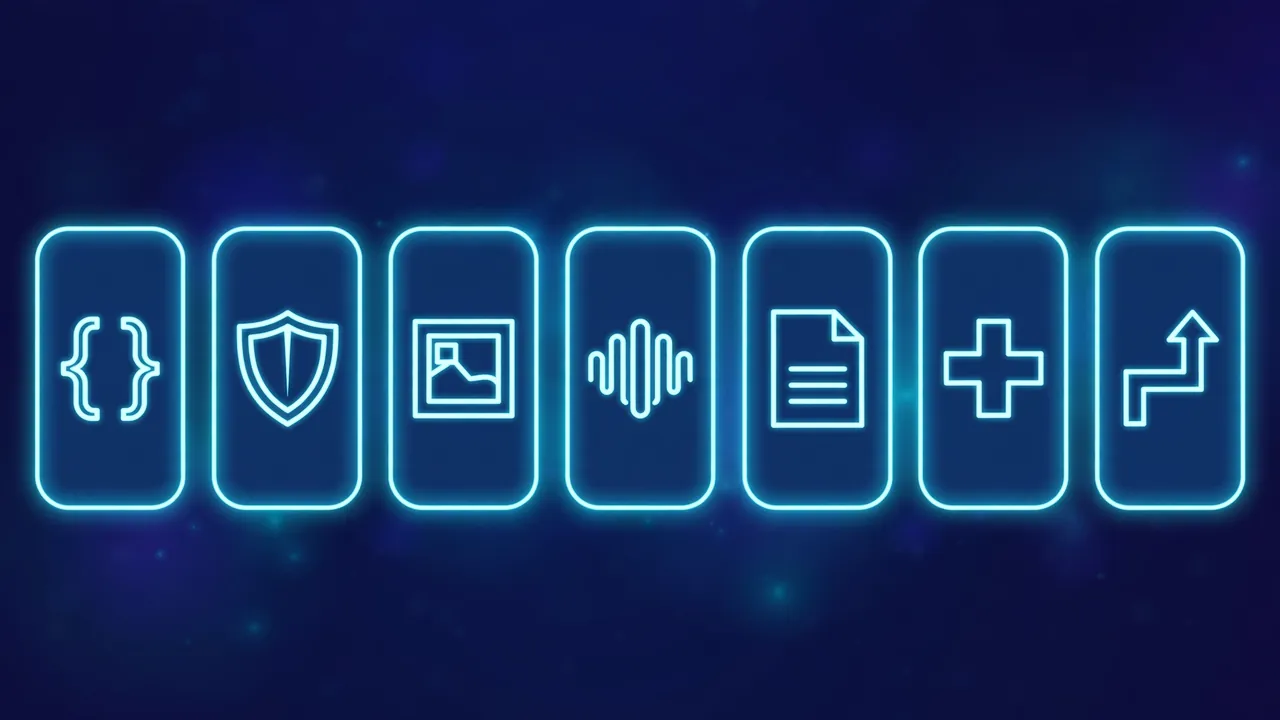
Microsoft announced seven MAI models at Ignite 2026: MAI Code 2, MAI Code 2 Flash, MAI Cyber 2 Flash, MAI Image 2.7, MAI Realtime 1, Dragon Copilot Transcribe, and Decision 1.1. They run on the Maia 200 accelerator and are available in GitHub Copilot and Microsoft Foundry. The shared pitch is price-performance, not raw capability.
The seven are Code 2 and Code 2 Flash for coding, Cyber 2 Flash for security, Image 2.7 for images, Realtime 1 for live voice, Dragon Copilot Transcribe for clinical notes, and Decision 1.1 for routing. Microsoft also announced MAI Image 2.7 Flash and MAI Licensed Weights, a program for running customized MAI models in a customer’s own Azure environment. The announcement came in a post on Microsoft AI titled “Seven new world-class models at scalable price-performance.” Suleyman summed up the approach on stage: “We don’t just hill-climb on frontier quality alone. We co-optimize quality and price together,” according to Thurrott’s keynote report. Microsoft is not claiming the best model on every test, only models close enough at a small fraction of the cost.
MAI Code 2 and the 98 percent claim
MAI Code 2 is Microsoft’s general purpose coding model for everyday enterprise work. Microsoft says it reaches 98 percent of GPT-6.1 Sol coding quality at about 40 percent of the price and 96 percent of Claude Opus 5.5 performance at about 5 percent of the price, averaged over four coding benchmarks. These are Microsoft’s own figures.
GitHub describes Code 2 as suited to deep debugging, multi-file implementation, refactoring, and repository-wide reasoning. It appears in the Copilot model picker across VS Code, Visual Studio, the CLI, the cloud agent, the Copilot app, github.com, GitHub Mobile, JetBrains, Xcode, and Eclipse, according to GitHub’s changelog as reported by S5 Labs. GitHub’s docs list a 1 million-token context window for both models. Microsoft averages its headline figures over four everyday enterprise coding benchmarks: DeepSWE 1.1, Terminal Bench 2.1, SWE-Atlas, and FrontierCode v1.1. Our report on OpenAI’s GPT-6 family and Claude Opus 4-5 report cover the two rivals Microsoft measures against. Microsoft also says developers preferred Code 2 over GPT-6 Sol 64 percent of the time in a blind frontend test. Microsoft says the models are built for everyday coding work, and are explicitly not yet tuned for fundamental science research or very long-horizon agentic work.
The comparison table: MAI Code 2 against its named rivals
The Microsoft MAI models Ignite 2026 announcement gives a head-to-head figure for nearly every model. Each number is Microsoft’s own claim, and the benchmarks were chosen by Microsoft. The table below collects them, and the notes after it explain the three cautions that apply to every row.
| Model | Microsoft’s claim | Benchmark or basis | Where it runs |
|---|---|---|---|
| MAI Code 2 | 98% of GPT-6.1 Sol quality at 40% of the price | DeepSWE 1.1, Terminal Bench 2.1, SWE-Atlas, FrontierCode v1.1 | GitHub Copilot |
| MAI Code 2 | 96% of Claude Opus 5.5 performance at 5% of the price | Same four coding benchmarks | GitHub Copilot |
| MAI Code 2 Flash | Comparable to GPT-6 Luna at 65% of the price | DeepSWE 1.1, Terminal Bench 2.1, SWE-Atlas | GitHub Copilot, Foundry limited preview |
| MAI Code 2 Flash | Comparable to Claude Haiku 5.5 at 20% of the price | Same three coding benchmarks | GitHub Copilot, Foundry limited preview |
| MAI Cyber 2 Flash | Beats GPT-6 Astra quality at less than 2% of the cost per task | CyberGym-E2E | MDASH, verified defenders |
| MAI Image 2.7 | Top rated for image editing at one fifth the price of GPT Image 2.6 | Artificial Analysis image editing ranking | Microsoft Foundry, MAI Labs limited preview |
| MAI Realtime 1 | Outperforms GPT-Realtime 2.1, from $0.01 per audio minute | Microsoft’s own external and Dynamics 365 benchmarks | Preview, demo in MAI Labs |
| Decision 1.1 | 50x faster and 79x cheaper than GPT-6.1 Sol | Artificial Analysis Decision Index | In applications, through Microsoft |
| MAI Image 2.7 Flash | About $10 per 1,000 images | Microsoft’s pricing | Microsoft Foundry |
Three cautions apply. First, “percent of the price” and “percent of the cost per task” are not the same measure. Second, Microsoft picked both the tests and the rivals, and no independent lab has repeated these runs yet. Third, the Copilot prices are promotional. GitHub lists MAI Code 2 at $0.50 per million input tokens and $2.50 output until May 17, 2027, when the rates double, and Flash at $0.05 and $0.25 until the same date, according to coverage of the changelog. Anyone budgeting past May 2027 should use the doubled rates.
Code 2 Flash and the everyday coding jobs
MAI Code 2 Flash is the cheaper, lighter coding model for high-volume everyday work. Microsoft says it performs comparably to GPT-6 Luna at 65 percent of the price and Claude Haiku 5.5 at 20 percent of the price, across three routine coding benchmarks. It is available on every Copilot plan, including Free and Student.
GitHub describes Flash as built for code explanations, targeted edits, routine fixes, and rapid iteration. MAI Code 2 sits on Copilot Pro, Pro+, Max, Business, and Enterprise. Flash sits on those plans plus Free and Student, though free tiers get models through automatic selection only. At the promotional rates, Flash costs one tenth of Code 2 per token: $0.05 per million input tokens and $0.25 per million output tokens, against $0.50 and $2.50 for Code 2. That makes Flash the sensible default for explanations and small edits, while Code 2 earns its price only on multi-file work and deep debugging. GitHub will retire MAI Code 1.1 Flash on December 18, 2026, and points users to the latest MAI Code Flash model instead.

Cyber defense at two percent of the rival’s cost
MAI Cyber 2 Flash is Microsoft’s security model for defenders, and its headline claim is the most aggressive in the whole family. Microsoft says it beats GPT-6 Astra quality at less than 2 percent of the cost per task on the CyberGym-E2E benchmark. It is built for monitoring and control agents that defend live production systems around the clock.
Security work is the clearest case for the price argument, because defense agents never stop. A model that watches a live system runs all day, every day, and a frontier model priced for occasional use becomes unaffordable at that volume. Microsoft says it was built with its own security data and expertise, on earlier MAI Cyber models defenders already use. Microsoft says MAI Cyber accounts for almost 40 percent of scans in MDASH, and 90 percent of scans that started with MAI continued to use it. The catch is access. Cyber 2 Flash is not in the Copilot picker for everyone. It is aimed at verified defenders through MDASH, so most readers cannot try it directly, and the 2 percent figure cannot be checked by the public.

Image, voice, and health: the rest of the family
MAI Image 2.7 is Microsoft’s image model and holds the family’s only independent ranking: number one on Artificial Analysis for image editing. MAI Realtime 1 handles live voice from $0.01 per audio minute, and Dragon Copilot Transcribe already covers 10 million patient encounters a month.
Microsoft says Image 2.7 takes the number one spot on Artificial Analysis for image editing, beating GPT Image 2.6 Sunburst (max) at one fifth of the price. The ranking matters because it is the one number that does not come from Microsoft’s own test rig, and the leaderboard is public. MAI Image 2.7 Flash, a high-volume version at about $10 per 1,000 images, is also in Microsoft Foundry. The practical question for image makers is the price per image and the Foundry license terms, so test with a small paid run first. Realtime 1 is Microsoft’s first live speech-to-speech model, built for natural, low-latency voice conversation. Microsoft says it outperformed GPT-Realtime 2.1 in its own benchmarks. It is in preview, with a demo in MAI Labs. Dragon Copilot Transcribe is built on MAI Transcribe 2, which Microsoft calls the world’s fastest and most accurate multilingual transcription model, and it now powers 100 percent of doctor-patient conversation transcriptions in Dragon Copilot. Microsoft says it covers 10 million encounters a month and reaches a third of US physicians. Those are usage figures, not lab scores, and they describe a product already running in clinics. TechDogs’ Ignite roundup confirms the same models and the wider Ignite context.
Decision 1.1 and Maia 200: the hardware underneath
Decision 1.1 is a routing model that sends each request to the cheapest model that can handle it, so big pricey models run only when needed. Microsoft says it leads rivals on the Artificial Analysis Decision Index. The Maia 200 accelerator runs the family in production at 1.7 times more tokens per watt.
Decision 1.1 is easy to overlook next to the coding and image models, and it may be the most important one for enterprise budgets. Microsoft says Decision 1.1 is used by 4,000 customers and runs 50 times faster and 79 times cheaper than GPT-6.1 Sol. The comparison names no task or configuration for the rival, so read it as a direction, not a precise saving. Underneath the family is Maia 200, Microsoft’s second-generation AI accelerator, now in production running the company’s largest models. Microsoft says it achieves 1.7 times more tokens per watt than the hardware it replaces. That efficiency is what lets Microsoft offer the low prices in this announcement. Microsoft also announced MAI Licensed Weights, which lets an organization customize a frontier MAI model and run it in its own Azure environment. AT&T is the named example: its custom MAI model for 5G network analytics outperformed GPT-6.1 Sol at one fiftieth of the cost, according to Microsoft.
Who should switch now and who should wait
Copilot Pro subscribers and teams with heavy routine coding should try the new models this week. MAI Code 2 gives Pro users a powerful model that used to sit on higher-priced plans, and Flash gives every plan a cheap model for everyday edits. Others should wait for independent tests.
Switch now if you pay for Copilot Pro, since Code 2 is a powerful-class model on the ten-dollar Pro plan rather than a Pro+ exclusive. Switch now if your team runs a high volume of routine coding, since Flash at $0.05 per million input tokens is cheap enough to leave on by default. Wait if your work is fundamental science research or very long-horizon agent work, since Microsoft says plainly that Code 2 is not yet tuned for either. Wait if you need independent verification before moving a production workflow, since every figure comes from Microsoft’s own testing. And wait before budgeting on launch prices, since the Copilot rates double on May 17, 2027. Set a spending cap before you start: GitHub’s advice is a bundled AI credits budget of zero dollars with usage stopping at the limit.

What the MAI family says about Microsoft’s OpenAI strategy
Microsoft spent years as OpenAI’s main backer, providing the computing power behind its models. The MAI family, the Maia 200 chip, and MAI Licensed Weights say Microsoft now wants to own the full stack itself. That is a hedge against dependence, not a break with OpenAI.
The evidence is in the same week’s changelog. GitHub added GPT-6.2 Astra and GPT-6.2 Sol to Copilot in the same November 17 changelog batch, so Microsoft ships OpenAI’s newest models alongside its own. The strategy is to make the in-house models the cheap default and keep outside models for the hardest jobs. It also explains the price-performance framing: Microsoft does not need Code 2 to beat GPT-6.1 Sol, only to come close at a fraction of the price. Our Gemini 4 Neon report shows Google making a similar move with a tiered model family, so this is now the pattern across the big labs. Readers should also remember that Microsoft’s cloud has had public failures this month, covered in our report on the Microsoft 365 outage. A cheaper model is only a saving if the platform stays up. Whether the quality claims hold up outside Microsoft’s own tests is the question the next few months will answer.

Frequently asked questions

What are the Microsoft MAI models announced at Ignite 2026?
The Microsoft MAI models Ignite 2026 announcement covers seven models: MAI Code 2, MAI Code 2 Flash, MAI Cyber 2 Flash, MAI Image 2.7, MAI Realtime 1, Dragon Copilot Transcribe, and Decision 1.1. They cover coding, cyber defense, image editing, live voice, clinical transcription, and model routing.
Where can I use MAI Code 2 today?
MAI Code 2 is in GitHub Copilot now on Pro, Pro+, Max, Business, and Enterprise plans. It appears in the model picker in VS Code, Visual Studio, the CLI, the cloud agent, the Copilot app, github.com, GitHub Mobile, JetBrains, Xcode, and Eclipse. Flash is also available on Free and Student plans.
How much does MAI Code 2 cost in GitHub Copilot?
GitHub lists MAI Code 2 at $0.50 per million input tokens and $2.50 output until May 17, 2027, when the rates double to $1.00 and $5.00. Flash costs $0.05 and $0.25 until the same date, then doubles to $0.10 and $0.50. Usage is billed through AI credits, where one credit equals one cent.
Is MAI Code 2 better than Claude Opus 5.5?
Microsoft does not claim it is better. Microsoft says Code 2 reaches 96 percent of Claude Opus 5.5 performance at about 5 percent of the price, averaged over four coding benchmarks Microsoft chose. That is a price-performance claim, not a capability win, and no independent lab has repeated the tests.
What is Maia 200?
Maia 200 is Microsoft’s second-generation AI accelerator, the chip that runs the MAI models in production. Microsoft says it delivers 1.7 times more tokens per watt than the hardware it replaces. It is the hardware reason Microsoft can offer the low prices in this announcement.
Can I run MAI models in my own Azure environment?
Yes, through MAI Licensed Weights. The program lets an organization customize a frontier MAI model and run it securely in its own Azure environment, keeping its data and adaptations under its own control. AT&T is the named example.